Tuesday, 3 July 2012

Tafsir Ibn Kathir

I come down early one morning recently and found a box decorated with animals in the front room.  I though it was rather a nice box and might be useful to store some of the kids stuff in.  Hubby had come home late from doing a house work and left it there.

I took a peek inside the box and found a full set of 10 volumes of Tafsir Ibn Kathir in immaculate condition.  I have been after a set of these for the last few years, but never got round to spending the £120 or so it costs.  Aren't I glad I didn't now!

Hubby confirmed that he did a house move the night before and had been given the books.  I was over the moon.  I told him he should have hidden them and given them to me on Eid, I would have been happy all year.  His face dropped when he realised the missed opportunity!

I really do like this man's job.


Friday, 27 January 2012

Book Review: The Poor King by Asma Iftikhar

The Poor King is the story of an old man who lives in a hut made of mud and straw. He insists he is a king with a palace and servants much to the amusements of villagers who look on him with fondness. He is happy with his solitary life, spending his time caring for his sheep and cattle and sitting on his worn old rug to reflect in silence.

This is until he falls sick and a number of people come to visit him, changing his life – the handsome cloth merchant who wants to take him home, the physician who wants to heal him and a final, unexpected little visitor.

The story appears to be an analogy of mans ability to be content with what he has or choose to be taken in by desire for the wealth of the world (dunya) and lose his contentment.

The language used is simple but evocative, with some startling images; the handsome merchant with his “olive skin and almond-shaped eyes”, the child in the startling white clothes, which stand out in a story that otherwise flows with a gentle rhythm.

This is not an easy book with a simple story and a happy ending, but a more layered story with the villagers in the background, the visitors own agenda’s and the kings behaviour and reactions not always obvious to interpret. I did wonder if my children would be able to understand the messages in the book.

The images accompanying the story are simple line drawings softly filled in with washes of soft colours creating an impression of what is happening and a mood rather than the clear and descriptive drawings you more commonly find in children’s books. The effect is haunting and it makes you wonder rather than tell you what to think.

This is a touching book to be read many times to get an understanding of what the messages behind the story are. One that will make children think and stay with them after they have finished it. My daughter’s verdict on the book: “I really liked it mum, it made me feel sad.”


image source

Sunday, 22 January 2012

Outstanding Book Reviews

These past few months I have been reading everything I can get my hands on, but moving onto the next book before I could get to do a book review. I am trying to organise the mess that has stacked up in my bedroom and gathered up this bag of books that need to be reviewed. Now where do I start?....


Thursday, 1 December 2011

Jannah Jewels: The Treasure of Timbaktu by Umm Nura

I am always on the lookout for good books for my children, including interesting and inspiring Islamic children’s book. Jannah Jewels caught my eye because of the adventurous looking girls on the over and the idea of a group of young girls going through numerous adventures. I liked that the book cover shows that the girls are of different races and have different styles – one of the things I love about this ummah is its variety and diversity.

Jannah Jewels are four ordinary looking Muslims girls with some extraordinary qualities. Each excels in one of the sunnah sports (horse-riding, archery and swimming, okay so maybe not the one that likes skateboarding), each has a role (leader, artist, encyclopaedia, environmentalist), a superpower, and a special gadget as well as her own fear (spiders is one).

Before reviewing I passed the book to my daughter to read, because I felt that it was her opinion that counted. She read the book in one sitting and absolutely raved about it. When asked what she liked, she described some of the more adventurous scenes from the book. Her favourite character was Iman (my favourite too – she is the clever one).

Reading the book myself, the first thing that struck me was the breadth of Islamic knowledge and history which was touched on, often quite lightly or in passing: mention of Mansa Musa, the great Jingerber Masjid of Timbuktu, Ibn Battuta’s Rihla, the Maghribi script, the village griot. I suspect most adults wouldn’t know what or who all of these are at first glance. I am super keen to get my children interested in Islamic history and cultures, so if these mentions pique their curiosity I will be very happy. The book sneaks in lots of facts such as:

“It says here that the Quranic Sankore University, had almost 50,000 Quranic students at one point. It was built by Al-Sahili. He was from the Spanish city of Grenada.”

I liked that the Jannah Jewels have to say “Bismillah” (I begin in the name of Allah) before they do anything and that when they need help they have to ask Allah (SWT) sincerely. More than this I liked that the characters remember to thank Allah (SWT) when help comes, how many times does Superman remember to do this?

I loved that the book quotes a hadith very beloved to me, written on the hilt of the Prophet’s (PBUH) sword:

“Forgive him who wrongs you; join him who cuts you off; do good to him who does evil to you; and speak the truth although it be against yourself.”

The book touches on various issues such as the environment and sustainability, the history of Africa and the richness of Islamic history. I wondered if children would be able to fully appreciate the authors attempt to highlight the fact that history can be subjective, for instance the negative stereotypes around Africa common today in comparison to the rich and sophisticated Africa of the past. As Mansa Musa says to the girls “I have believed in Africa for a long time. I believe in its history and its academic and spiritual power.” Certainly a noble attempt and one I hope made my daughter think.

Probably the only criticism I might have with the book is that jumps very quickly from one scenario to another, but this is understandable when you consider how much is crammed into this little book its energetic pace.

Overall I am glad I got my hands on the book and I am looking forward to the next edition. I could really feel the love that went into this book – the characters, the places, the history, and the things that the author clearly strongly believes in and wants to share with our children and the wider world through her heroines.

My daughter’s verdict? “I would give the book a 10 out of 10 mum”

Sunday, 13 November 2011

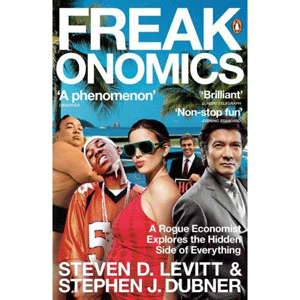
Freakonomics: A Rogue Economist Explores the Hidden Side of Everything by Steven Levitt and Stephen J. Dubner

A book on economics? A book by an economist and a New York Times journalist? A book about random subjects with no specific theme that connects them all? Who would read a book like that?

When Shutterbug Sister recommended this to be, I had to give it a try as she has lent me a few very good books. The cover made me look twice – I wouldn’t have thought books about economics have rappers, glamorous-looking pregnant women or sumo wrestlers on them.

But Freakonomics perspective is different, rather than working with sources and sets of data that tell stories about crime, education or poverty, Levitt compares disparate, almost random seeming sets of data to see what they throw up. So crime figures are compared to abortion rates, the control of information to the rise and fall of the KKK and the names of babies are compared to people’s socioeconomic status.

Levitt starts out by asking a question – why do drug dealers live at home with their mothers if they earn so much? Does the way you raise your child have any impact on their chance of success in life? Dies the name you give have any impact on their chance of success in life?

The book is accessible and easy enough to understand. The narrative is disparate and varied, jumping from sumo’s to crack dealers to the KKK, but it always remains interesting and engaging. The exception is where the books start’s to discuss the authors methodology – how data sets were extracted and what was done to them to find trends and patterns. I suspect anyone without an interest in statistics or research methodology might start to lose patience at this point.

Regardless this is an interesting book that throws up some very surprising findings – most drug dealers don’t actually earn very much, sumo’s might be cheating (absolute blasphemy to the Japanese), the numerous things we break our back doing to raise our children to be successful might not actually make any difference (as a lazy mama, I was rather gleeful at the last one!).

Probably not one I would recommend to everybody, but if you like reading about issues that are current and if you want to read something that will make you sit up and argue (I wasn’t convinced by everything the authors were saying), then this might be for you.

You can see some of the content of the book and other similar topics the authors have explored at the Freakonomics blog here.


Book Love: Dr Zeus Book Charm Bracelet